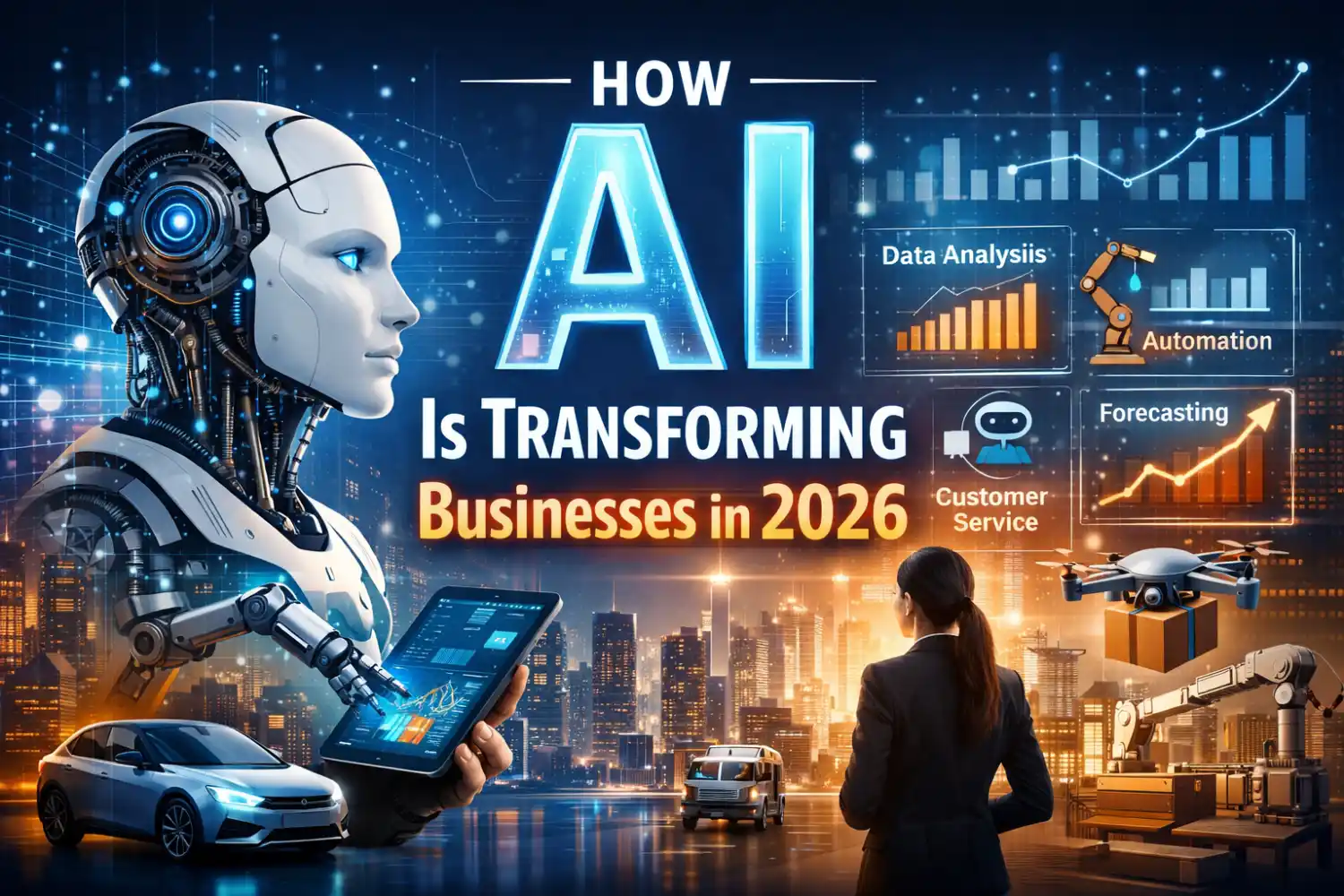
How Artificial Intelligence is Transforming Businesses in 2026
Meta Description: Explore how AI for business in 2026 is revolutionizing operations, marketing, and decision-making. Learn key AI tools, benefits, and strategies for smarter businesses.
Keywords: AI for business, AI tools 2026, AI in marketing, AI automation, business intelligence AI, AI strategy
Introduction
In 2026, Artificial Intelligence (AI) has become a cornerstone for business growth and innovation. Companies worldwide are leveraging AI to automate processes, improve customer experience, optimize marketing campaigns, and enhance decision-making. From startups to large enterprises, AI adoption is no longer optional—it’s a strategic necessity.
This article explores how AI is transforming business operations, the top AI tools for businesses, and strategies to implement AI successfully while maximizing ROI.
What is AI for Business?
AI for business refers to the application of Artificial Intelligence technologies to enhance productivity, efficiency, and profitability in business operations. AI systems use machine learning, natural language processing, and data analytics to perform tasks traditionally requiring human intelligence.
Applications include:
- Automating repetitive tasks
- Predicting market trends
- Improving customer support
- Personalizing marketing campaigns
- Enhancing operational efficiency
With AI, businesses can make faster, smarter decisions and gain a competitive advantage in increasingly digital markets.
Key Benefits of AI in Business
1. Process Automation
AI can handle repetitive tasks like data entry, invoicing, and scheduling. Robotic Process Automation (RPA) tools combined with AI enable employees to focus on strategic and creative work.
Example: AI-powered chatbots automatically answer customer queries 24/7, reducing human labor costs.
2. Data-Driven Decision Making
AI systems can analyze vast amounts of data, uncover patterns, and provide actionable insights. Companies use predictive analytics to forecast demand, optimize supply chains, and reduce operational risks.
Example: Retail companies predict seasonal demand using AI, minimizing stock shortages or overproduction.
3. Personalized Marketing
AI tools can analyze customer behavior, preferences, and engagement patterns. Marketers can then deliver highly targeted campaigns, emails, and product recommendations.
Example: Netflix and Spotify-style recommendation engines increase engagement and sales using AI.
4. Improved Customer Experience
AI chatbots, virtual assistants, and voice recognition tools improve response times, personalization, and customer satisfaction. AI can also detect sentiment from customer feedback and alert teams to address concerns proactively.
5. Cost Reduction
By automating tasks and improving efficiency, AI significantly reduces operational costs. Predictive maintenance in manufacturing, for instance, avoids expensive equipment failures.
Top AI Tools for Business in 2026
1. ChatGPT and Custom GPTs
Ideal for content creation, customer service, and internal communication automation. Businesses use AI-powered writing assistants to generate emails, reports, product descriptions, and FAQs.
Benefits: Saves time, reduces human errors, improves communication quality.
2. Jasper AI
Specialized in marketing content creation. Jasper generates SEO-optimized blog posts, ad copies, and social media campaigns, helping businesses improve online presence.
Benefits: Faster content creation, SEO-ready outputs, consistent brand tone.
3. Surfer SEO
AI-powered SEO tool that analyzes competitors, recommends keywords, and optimizes content to rank higher on search engines.
Benefits: Improves organic traffic and visibility, integrates with content workflows.
4. Runway ML
For businesses creating video content, Runway ML uses AI to generate, edit, and enhance videos automatically.
Benefits: Saves time and reduces production costs, professional video output without advanced skills.
5. Perplexity AI
An AI research assistant that provides real-time, cited answers and insights. Helps teams make data-backed decisions quickly.
Benefits: Reliable, faster research, reduces manual effort in data collection.
6. Canva AI
AI-powered design tool for marketing visuals, social media graphics, and presentations.
Benefits: Quick creation of professional-looking designs, enhances brand aesthetics.
Implementing AI in Business: Best Practices
1. Identify Key Business Areas
Start by analyzing which processes can benefit most from AI, such as customer support, marketing, logistics, or data analysis.
2. Start Small, Scale Gradually
Begin with pilot AI projects, evaluate ROI, then expand AI implementation across departments.
3. Train Your Team
Ensure employees understand AI tools and workflows. Training ensures smooth adoption and reduces resistance.
4. Combine AI with Human Intelligence
AI should augment human work, not replace it. Complex decisions and creative tasks still require human judgment.
5. Focus on Data Quality
AI systems depend on high-quality data. Ensure data is accurate, structured, and secure for optimal AI performance.
Emerging Trends in AI for Business
-
Autonomous AI Agents – AI systems that complete tasks independently, such as scheduling, research, and reporting.
-
AI in Finance – Fraud detection, predictive analytics, and automated trading are becoming standard.
-
Voice and Visual AI – Using speech recognition and computer vision for customer service and inventory management.
-
Ethical AI and Governance – Companies are prioritizing transparency, privacy, and ethical AI usage to build trust.
Challenges of AI Implementation
- High Initial Costs – AI infrastructure and integration require significant investment.
- Data Privacy Concerns – Handling sensitive customer data responsibly is critical.
- Skill Gap – Teams need training to manage AI effectively.
- Overreliance on AI – Human oversight is essential to prevent errors and ethical issues.
Conclusion
In 2026, AI for business is no longer optional—it’s a strategic advantage. From automating tasks and enhancing marketing to driving data-driven decisions, AI tools empower companies to operate smarter and faster.
By integrating tools like ChatGPT, Jasper, Surfer SEO, Runway ML, and Perplexity AI, businesses can streamline operations, increase efficiency, and improve customer experience.
Whether you’re a small startup or a large enterprise, embracing AI today ensures your business remains competitive and future-ready.