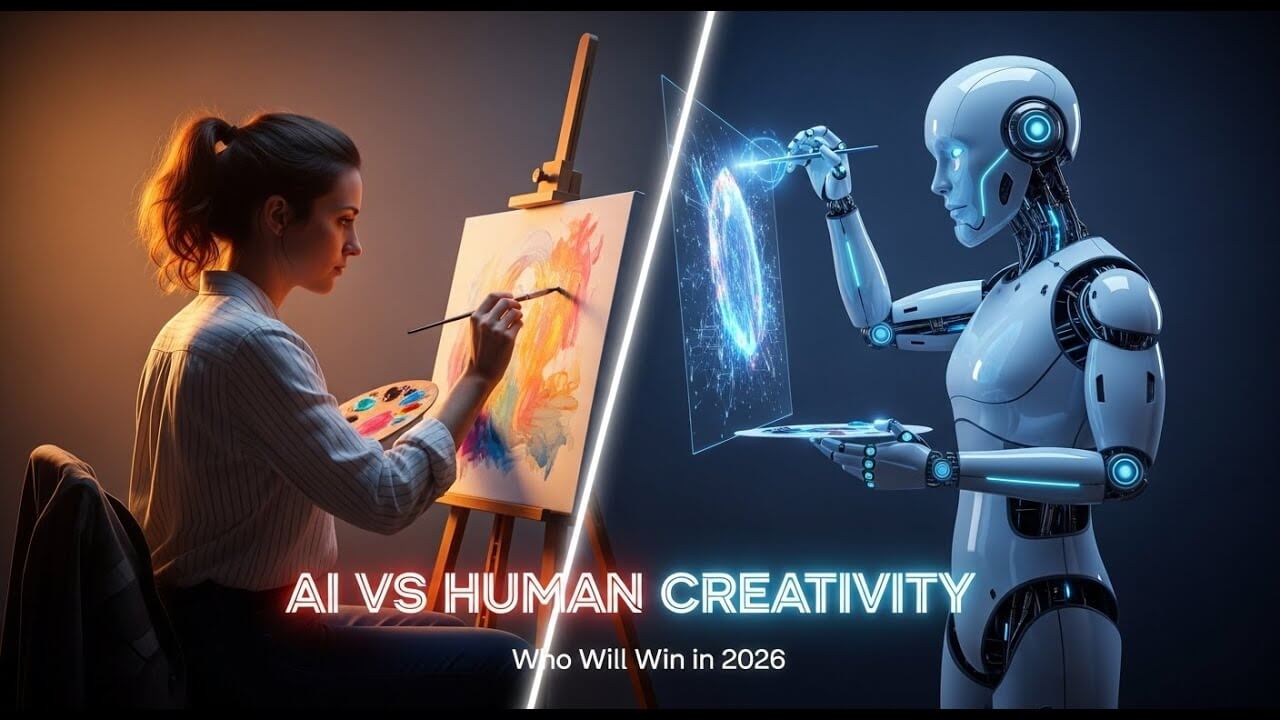
AI vs Human Creativity:Who Wins in 2030?
By 2030, artificial intelligence will write novels, paint portraits, compose symphonies — and still not know why a sunset makes you cry. The real question is not who creates better, but who creates with meaning.
The Rise of AI-Generated Content
Over the past few years, AI-generated art has exploded from a curious experiment into a full-blown creative industry. Tools like Midjourney, DALL·E, and Sora are producing images, videos, and music that rival professional human work — at a fraction of the cost and time. By 2030, these tools will be far more powerful. A single prompt may generate a full feature film, a personalized novel, or a marketing campaign tailored to a specific audience of one.
This is not a distant fantasy. Today, AI is already writing product descriptions, generating social media content, designing logos, and even composing background music for YouTube videos. Small businesses that once needed entire creative teams now rely on AI tools to produce content at scale. The future of AI in creative industries is already here — it is just unevenly distributed.
What Makes Human Creativity Unique?
Despite all this progress, human creativity has something AI fundamentally lacks: lived experience. A human artist paints grief because they have lost someone. A human writer captures loneliness because they have sat in a quiet room and felt it. This emotional depth — rooted in the human body, in culture, in suffering and joy — is what separates creative thinking in humans from pattern recognition in machines.
AI learns from data. It identifies what has worked before and recombines it with remarkable efficiency. But creativity, at its highest level, is not recombination. It is rupture. It is the moment when an artist breaks every rule they were taught and creates something the world has never seen. That impulse — born from rebellion, from pain, from wonder — does not come from a training dataset.
"AI can imitate every brushstroke ever made. But it cannot decide, for the first time, to throw the brush away."
Can AI Be Truly Creative?
This is the central debate in AI creativity research. Some researchers argue that creativity is simply a complex form of pattern recognition, and if AI can pattern-match well enough, it is creative by definition. Others insist that real creativity requires consciousness, intentionality, and the ability to assign personal meaning to an act.
By 2030, AI will likely pass every surface-level test of creativity. It will produce work that is beautiful, technically perfect, and emotionally resonant — to most observers. But whether it is truly creating or merely simulating creation is a philosophical question that may never be fully resolved. What we do know is that AI vs human creativity is not a binary competition. It is a collaboration in progress.
Jobs, Artists, and the 2030 Creative Economy
One of the most urgent questions is economic. Will AI replace creative jobs entirely? The honest answer is: some, yes. Roles that rely on producing high volumes of standard content — stock imagery, basic copywriting, template-based design — are already being automated. By 2030, this shift will accelerate dramatically.
However, new roles are also emerging. AI prompt engineers, creative directors who specialize in guiding AI tools, and hybrid artists who use AI as a medium are all growing categories. The creative economy of 2030 will reward those who can work with AI, not against it. The artists who thrive will be those who use AI to amplify their vision, not those who refuse to acknowledge it exists.
Think of it like photography and painting. When cameras were invented, many predicted the death of portrait painting. Instead, painting became more expressive, more abstract, more human — because it no longer needed to be merely representational. AI may do the same for writing, music, and visual art.
Who Actually Wins in 2030?
The honest answer: neither wins alone — and that is a good thing. In 2030, the most powerful creative work will be the product of human-AI collaboration. AI will handle the technical execution, the rapid iteration, the vast data processing. Humans will provide the vision, the meaning, the cultural context, and the emotional stakes.
Human creativity and AI are not opposites. They are tools that, when combined thoughtfully, can produce things neither could achieve alone. A novelist who uses AI to draft chapters at speed, then rewrites them with emotional depth. A musician who generates a hundred melodic variations with AI, then chooses the one that breaks their own heart.
The creators who will be left behind in 2030 are not those without AI skills. They are those who believe creativity is about technique alone. Creativity has always been, at its core, about having something to say. AI can say many things — but it does not yet know why anything matters.
Final Verdict
By 2030, AI will be the most powerful creative tool in human history. It will democratize art, accelerate innovation, and change every creative industry on earth. But it will not replace the human need to create — or the uniquely human ability to create with purpose, pain, and meaning.
In the end, the question "AI vs Human Creativity: Who Wins?" has only one real answer: the audience wins. We are about to live through the greatest explosion of creative output the world has ever seen. How we use that power — what we choose to say with it — will define not just art, but what it means to be human in 2030.