Immunology Department at UHS | Education, Research & Academic Programs
The immune system works quietly, yet it plays one of the most important roles in keeping us alive. Every day, without us even noticing, it fights off germs, repairs damage, and protects the body from serious threats. Whether it is a mild flu or a life-threatening disease like cancer, the immune system stands at the center of defense. Understanding how it works is essential for modern medicine, and in Pakistan, this responsibility is taken seriously by the Immunology Department at University of Health Sciences.
At UHS, immunology is not treated as just another subject in a textbook. Instead, it is approached as a living science—one that grows through research, questioning, and hands-on learning. From the beginning, UHS aimed to prepare future doctors and researchers who truly understand how the human body protects itself. This vision shaped the Department of Immunology, turning it into a space where learning and discovery go hand in hand.
The Immunology Department at UHS was created with a clear purpose: to connect theory with real-world medical practice. Students do not only memorize immune responses; they learn how these responses matter in hospitals, clinics, and research labs. Immunology naturally connects with many medical fields, including pathology, microbiology, oncology, and genetics. At UHS, this connection is emphasized so students can see the bigger picture of healthcare.
One of the key ideas taught at UHS is how the immune system tells the difference between what belongs to the body and what does not. This concept helps students understand infections, allergies, autoimmune diseases, and transplant rejection. Through this foundation, graduates develop strong analytical skills and become better prepared to solve medical problems in real life.
Students enter the immunology program at UHS through different paths. Some join during their medical education, while others return for advanced degrees such as M.Phil. or PhD programs. Regardless of their level, the academic environment is demanding but supportive. At UHS, students are encouraged to keep up with global scientific progress while strengthening their understanding of core concepts like innate and adaptive immunity.
Teaching at UHS goes beyond lectures. Practical laboratory work is a major part of the learning process. Students handle samples, run experiments, and learn how research is conducted under proper scientific standards. Group discussions, journal reviews, and case-based learning help students think critically instead of relying on rote memorization. By the time they graduate, students from UHS carry both knowledge and confidence.
Research is one of the strongest pillars of UHS. The Immunology Department is supported by well-equipped laboratories that allow students and faculty to explore important health issues. Research topics are carefully chosen to address challenges faced by Pakistan. At UHS, scientists are actively studying immune responses in cancer, improving vaccine strategies, and analyzing how the body reacts during infectious diseases.
This research culture makes UHS more than just an educational institution. It becomes a contributor to national healthcare development. Students are not treated as passive learners; they are involved in projects that test ideas, analyze data, and sometimes influence future medical practices. UHS provides access to modern tools and techniques, helping students turn curiosity into meaningful outcomes.
The influence of UHS extends far beyond its Lahore campus. As a central regulatory and examining body, UHS oversees medical and dental institutions across Punjab. More than a hundred colleges follow curricula, assessment methods, and academic guidelines set by UHS. This gives the university a powerful role in shaping how immunology and other medical subjects are taught across the province.
Through workshops, faculty development programs, and professional training sessions, UHS continues to guide educators and clinicians. Doctors attending these programs often leave with fresh perspectives on medical science and patient care. In this way, the impact of UHS quietly spreads into hospitals and classrooms far beyond its own walls.
What truly defines UHS is its culture of inquiry. The university does not promote learning through fear or rigid hierarchy. Instead, students are encouraged to ask questions, challenge assumptions, and seek better explanations. The Immunology Department reflects this philosophy clearly. Learning here is active, thoughtful, and driven by curiosity.
UHS does not promise quick success or instant fame. Its strength lies in steady progress and long-term impact. Students trained at UHS grow into professionals who value evidence, ethics, and lifelong learning. They understand that medicine evolves, and so must they.
About UHS
Located in Lahore, UHS was established in 2002 with the goal of improving medical education across Punjab. Before UHS, medical education lacked consistency. By bringing institutions under one umbrella, UHS standardized curricula, examinations, and academic quality. While UHS runs its own programs, its broader role as a supervisory body makes it one of the most influential health-education institutions in Pakistan.
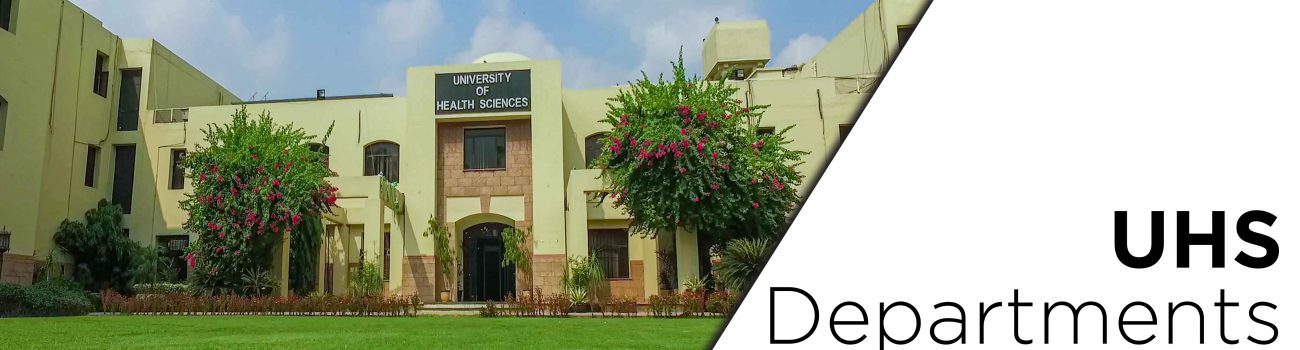
The UHS campus reflects its forward-looking mindset. Modern classrooms, advanced laboratories, libraries, and the well-known Shams Auditorium support both teaching and research. Yet, the true value of UHS lies in its vision. From early on, UHS invested in fields like Nursing, Allied Health Sciences, Medical Education, and Human Genetics—areas often overlooked in traditional medical systems.
Research remains central to UHS. The university addresses real health problems affecting Pakistani communities, from genetic disorders to infections and cancers. Students trained at UHS gain more than clinical knowledge; they learn how to think, investigate, and adapt. The ultimate goal of UHS is clear: to produce healthcare professionals who can care today and innovate for tomorrow.