Deforestation: causes, effects and control strategies
The steady loss of trees is one of the biggest challenges the world faces today. It might seem like a problem far away, deep in the forests, but deforestation affects everyone. Trees are more than just part of the landscape; they help control the climate, protect animals, and support human life. When forests disappear, the harm doesn't stop at the cleared land. Even though some areas are seeing less deforestation, large parts of forests are still being lost every year, and the long-term effects are hard to undo.
At its heart, deforestation is connected to human needs and economic pressures.
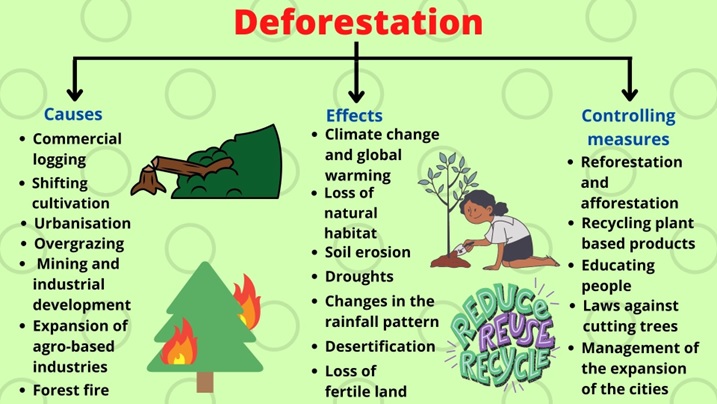
The main cause is agriculture. Forests are cut down to grow crops like soy, corn, and palm oil, or for raising cattle. These activities bring money, but they have serious environmental costs. Small-scale farming also plays a role. In many rural areas, families cut down trees just to survive, grow food, or build homes. Roads, dams, and mining projects also speed up deforestation by opening up forests to lasting damage.
Logging is another big factor, especially when it happens illegally.
When valuable trees are removed without proper rules, the forest becomes weaker and more at risk. Roads built for logging allow more people into the area, leading to more clearing for homes and farms. Over time, what starts as selective cutting can lead to full deforestation. This cycle happens all over the world, driven by the demand for wood, land, and resources.
Beyond the obvious causes, there are deeper issues fueling deforestation.
Weak laws and unclear land ownership make forests easy targets. When no one officially owns or watches over a piece of land, it is often taken advantage of. Global demand also plays a major part. Products used in cities far away can drive deforestation in distant tropical regions. Many communities depend on forest land because they don’t have better job options, making deforestation seem like the only choice.
Population growth adds more pressure.
As the number of people increases, so does the need for food, housing, and energy. This rising need makes deforestation seem necessary to policymakers and businesses. The result is a repeating pattern where forests are sacrificed for development. Breaking this cycle requires understanding that deforestation is more than an environmental issue—it's also social and economic.
The environmental damage from deforestation is huge.
Trees absorb carbon dioxide, helping keep the planet cool. When forests are cut down, that stored carbon is released into the air, making climate change worse. At the same time, fewer trees are left to absorb future emissions. This double effect means deforestation plays a major role in global warming. Forests that once helped keep temperatures stable now add to the problem.
Wildlife suffers badly from deforestation.
Forests are home to most land animals and plants. When trees are removed, animals lose their homes, food, and breeding grounds. Many species face extinction because they can't adapt fast enough. Deforestation also changes rainfall patterns, as trees help move moisture through the air. Without forests, some areas get droughts while others face extreme floods.
People also face big consequences.
Indigenous groups and communities that rely on forests depend on trees for food, medicine, shelter, and culture. Deforestation takes away these essentials, often forcing people to leave. Without tree roots to hold the soil, floods and landslides become more common, destroying homes and farmland. Local economies weaken, and competition over limited resources can lead to conflict. In this way, deforestation slowly destroys entire ways of life.
To solve deforestation, we need to address both its causes and effects.
The first step is understanding where and why forests are being lost. Modern satellite tools help monitor deforestation in real time, making it easier to react quickly. Stronger land laws and clearer ownership rights can stop illegal clearing. Governments need better coordination and enforcement to protect forests instead of exploiting them.
Financial solutions also matter.
Supporting sustainable farming, rewarding forest conservation, and punishing illegal deforestation can change how people act. International cooperation helps too, especially when wealthier nations support conservation efforts in poorer areas. These combined efforts can cut deforestation while still allowing economic growth.
Technology and awareness among consumers are becoming powerful tools in fighting deforestation.
Companies that refuse to buy products linked to deforestation help improve practices along supply chains. When people choose responsibly made products, they quietly reduce the demand that drives forest loss. Empowering local communities with education, resources, and decision-making power also leads to lasting protection.
Deforestation is a complex problem, but it's not impossible to solve.
With shared responsibility, better policies, and conscious choices, the damage can be slowed and even reversed. Protecting forests means protecting the future—for nature, for communities, and for the planet we all depend on.